Free Portal Frame Design Software
- Steel Structure Design Software Free Download
- Steel Portal Frame Design
- Free Steel Portal Frame Design Software
Portal frames are generally low-rise structures, comprising columns and horizontal or pitched rafters, connected. Resistance to lateral and vertical actions is provided by the rigidity of the connections and the bending stiffness of the members, which is increased by a suitable haunch or deepening of the rafter sections. This form of structure is stable in its plane and provides a clear span that is unobstructed by bracing.Portal frames are very common, in fact 50% of constructional steel used in the UK is in portal frame construction.
They are very efficient for enclosing large volumes, therefore they are often used for, storage, and commercial applications as well as for agricultural purposes.This article describes the anatomy and various types of portal frame and key design considerations. Principal components of a portal framed buildingA portal frame building comprises a series of transverse frames longitudinally. The primary steelwork consists of columns and rafters, which form portal frames, and bracing.
Steel Structure Design Software Free Download
The end frame (gable frame) can be either a portal frame or a braced arrangement of columns and rafters.The consists of for walls and for the roof. The secondary steelwork supports the, but also plays an important role in restraining the primary steelwork.The separate the enclosed space from the external environment as well as providing. The structural role of the cladding is to transfer loads to and also to restrain the flange of the purlin or rail to which it is attached. Portal framed structures - overview Types of portal framesMany different forms of portal frames may be constructed. Frame types described below give an overview of types of portal construction with typical features illustrated. This information only provides typical details and is not meant to dictate any limits on the use of any particular structural form.Pitched roof symmetric portal frameGenerally fabricated from with a substantial eaves haunch section, which may be cut from a rolled section or fabricated from plate.
25 to 35 m are the most efficient spans.Pitched roof symmetric portal frameLancashire Waste DevelopmentPortal frame with internal mezzanine floorOffice accommodation is often provided within a portal frame structure using a partial width mezzanine floor.The assessment of frame stability must include the effect of the mezzanine; guidance is given in.Portal frame with internal mezzanine floorWaters Meeting Health Centre, Bolton(Image courtesy BD Structures Ltd. And Kloeckner Westok)Crane portal frame with column bracketsWhere a travelling crane of relatively low capacity (up to say 20 tonnes) is required, brackets can be fixed to the columns to support the crane rails. Use of a tie member or rigid column bases may be necessary to reduce the eaves deflection.The spread of the frame at crane rail level may be of critical importance to the functioning of the crane; requirements should be agreed with the client and with the crane manufacturer.Tied portal frameIn a tied portal frame the horizontal movement of the eaves and the bending moments in the columns and rafters are reduced. A tie may be useful to limit spread in a crane-supporting structure.The high axial forces introduced in the frame when a tie is used necessitate the use of second-order software when analysing this form of frame.Mono-pitch portal frameA mono pitch portal frame is usually chosen for small spans or because of its proximity to other buildings. Dimensions used for analysis and clear internal dimensionsA critical decision at the stage is the overall height and width of the frame, to give adequate clear internal dimensions and adequate clearance for the internal functions of the building. Clear span and heightThe clear span and height required by the client are key to determining the dimensions to be used in the design, and should be established early in the design process. The client requirement is likely to be the clear distance between the flanges of the two columns – the span will therefore be larger, by the section depth.
Any requirement for brickwork or blockwork around the columns should be established as this may affect the design span.Where a clear internal height is specified, this will usually be measured from the finished floor level to the underside of the haunch or suspended ceiling if present. Main frameThe main (portal) frames are generally from with a substantial eaves haunch section, which may be cut from a rolled section or fabricated from plate. A typical frame is characterised by:. A span between 15 and 50 m. An clear height (from the top of the floor to the underside of the haunch) between 5 and 12 m. A roof pitch between 5° and 10° (6° is commonly adopted).
A frame spacing between 6 and 8 m. Haunches in the rafters at the eaves and apex. A stiffness ratio between the column and rafter section of approximately 1.5. Light gauge. Light gauge diagonal ties from some to restrain the inside flange of the frame at certain locations.
Haunch dimensions. Typical haunch with restraintsThe use of a haunch at the eaves reduces the required depth of rafter by increasing the moment resistance of the member where the applied moments are highest. The haunch also adds stiffness to the frame, reducing deflections, and facilitates an efficient bolted.The eaves haunch is typically cut from the same size rolled section as the rafter, or one slightly larger, and is welded to the underside of the rafter. The length of the eaves haunch is generally 10% of the frame span.
The haunch length generally means that the hogging moment at the end of the haunch is approximately equal to the largest sagging moment close to the apex. The depth from the rafter axis to the underside of the haunch is approximately 2% of the span.The apex haunch may be cut from a rolled section – often from the same size as the rafter, or fabricated from plate. The apex haunch is not usually and is only used to facilitate a bolted connection. Positions of restraints. General arrangement of restraints to the inside flangeDuring initial design the rafter members are normally selected according to their cross sectional. In later design stages needs to be verified and restraints positioned judiciously.The is likely to be more significant in the selection of a column size, as there is usually less freedom to position rails to suit the design requirements; rail position may be dictated by doors or windows in the elevation.If introducing intermediate lateral restraints to the column is not possible, the will determine the initial section size selection.
It is therefore essential to recognise at this early stage if the side rails may be used to provide to the columns. Only continuous side rails are effective in providing.
Side rails interrupted by (for example) roller shutter doors, cannot be relied on as providing adequate restraint.Where the compression flange of the rafter or column is not restrained by, restraint can be provided at specified locations by column and rafter stays to the inside flange. ActionsAdvice on actions can be found in BS EN 1991, and on the combinations of actions in BS EN 1990.
It is important to refer to the UK National Annex for the relevant Eurocode part for the structures to be constructed in the UK. Permanent actionsPermanent actions are the self weight of the structure, secondary steelwork. Where possible, unit weights of materials should be obtained from manufacturers’ data. Where information is not available, these may be determined from the data in BS EN 1991-1-1.
Service loadsService loads will vary greatly depending on the use of the building. In portal frames heavy point loads may occur from suspended walkways, air handling units etc. It is necessary to consider carefully where additional provision is needed, as particular items of plant must be treated individually.Depending on the use of the building and whether are required, it is normal to assume a service loading of 0.1–0.25 kN/m 2 on plan over the whole roof area. Variable actions Imposed roof loads Imposed loads on roofs Roof slope, αq k (kN/m²)α 60°0Imposed loads on roofs are given in the UK NA to BS EN 1991-1-1, and depend on the roof slope. A point load, Q k is given, which is used for local checking of roof materials and fixings, and a uniformly distributed load, q k, to be applied vertically. The loading for roofs not accessible except for normal maintenance and repair is given in the table on the right.It should be noted that imposed loads on roofs should not be combined with either snow or wind. Snow loadsSnow loads may sometimes be the dominant gravity loading.

Their value should be determined from BS EN 1991-1-3 and its UK National Annex – the determination of snow loads is described in Chapter 3 of the.Any drift condition must be allowed for not only in the design of the frame itself, but also in the design of the purlins that support the roof cladding. The intensity of loading at the position of maximum drift often exceeds the basic minimum uniform snow load. The calculation of drift loading and associated purlin design has been made easier by the major purlin manufacturers, most of whom offer free software to facilitate rapid design.
Wind actionsWind actions in the UK should be determined using BS EN 1991-1-4 and its UK National Annex. This Eurocode gives much scope for national adjustment and therefore its annex is a substantial document.Wind actions are inherently complex and likely to influence the final design of most buildings. The designer needs to make a careful choice between a fully rigorous, complex assessment of wind actions and the use of simplifications which ease the design process but make the loads more conservative. Free software for establishing wind pressures is available from purlin manufacturers.For more advice refer to Chapter 3 of the and. Crane actions. Gantry girders carrying an overhead travelling craneThe most common form of craneage is the overhead type running on beams supported by the columns.
The beams are carried on cantilever brackets or, in heavier cases, by providing dual columns.In addition to the self weight of the cranes and their loads, the effects of acceleration and deceleration have to be considered. Collapse mechanism of a portal with a lean-to under fire, boundary condition on gridlines 2 and 3.In the United Kingdom, structural steel in single storey buildings does not normally require.
The most common situation in which it is required to the structural steelwork is where prevention of fire spread to adjacent buildings, known as a, is required. Bending moment diagram resulting from the of a symmetrical portal frame under symmetrical loadingThe term is used to cover both rigid-plastic and elastic-plastic analysis. Commonly results in a more economical frame because it allows relatively large redistribution of bending moments throughout the frame, due to plastic hinge rotations. These plastic hinge rotations occur at sections where the bending moment reaches the plastic moment or resistance of the cross-section at loads below the full ULS loading.The rotations are normally considered to be localised at “plastic hinges” and allow the capacity of under-utilised parts of the frame to be mobilised. For this reason members where plastic hinges may occur need to be, which are capable of accommodating rotations.The figure shows typical positions where plastic hinges form in a portal frame. Two hinges lead to a collapse, but in the illustrated example, due to symmetry, designers need to consider all possible hinge locations.A typical bending moment diagram resulting from an of a frame with pinned bases is shown the figure below. In this case, the maximum moment (at the eaves) is higher than that calculated from a.
Both the column and haunch have to be designed for these large bending moments.Where deflections (SLS) govern design, there may be no advantage in using for the ULS. If stiffer sections are selected in order to control deflections, it is quite possible that no plastic hinges form and the frame remains elastic at ULS.
Portal frame analysis software(Fastrak model courtesy of ) In-plane frame stabilityWhen any frame is loaded, it deflects and its shape under load is different from the un-deformed shape. The deflection has a number of effects:. The vertical loads are eccentric to the bases, which leads to further deflection. The apex drops, reducing the arching action. Applied moments curve members; Axial compression in curved members causes increased curvature (which may be perceived as a reduced stiffness.)Taken together, these effects mean that a frame is less stable (nearer collapse) than a suggests.
The objective of assessing frame stability is to determine if the difference is significant. Second order effects.
P-δ and P-Δ effects in a portal frameThe geometrical effects described above are second-order effects and should not be confused with non linear behaviour of materials.As shown in the figure there are two categories of second-order effects:. Effects of displacements of the intersections of members, usually called P-Δ effects.
Diagrammatic representation of a portal frame rafterThe figure shows a diagrammatic representation of the issues that need to be addressed when considering the stability of a member within a portal frame, in this example a rafter between the eaves and apex. The following points should be noted:. Purlins provide intermediate lateral restraint to one flange. Depending on the bending moment diagram this may be either the tension or compression flange. Restraints to the inside flange can be provided at purlin positions, producing a torsional restraint at that location.In-plane, no member buckling checks are required, as the global analysis has accounted for all significant in-plane effects. The analysis has accounted for any significant second-order effects, and frame imperfections are usually accounted for by including the in the analysis. The effects of in-plane member imperfections are small enough to be ignored.Because there are no minor axis moments in a portal frame rafter, Expression 6.62 simplifies to: Rafter design and stabilityIn the plane of the frame rafters are subject to high bending moments, which vary from a maximum ‘hogging’ moment at the junction with the column to a minimum sagging moment close to the apex.
Compression is introduced in the rafters due to actions applied to the frame. The rafters are not subject to any minor axis moments.Optimum design of portal frame rafters is generally achieved by use of:. A cross section with a high ratio of I yy to I zz that complies with the requirements of under combined major axis bending and axial compression. A haunch that extends from the column for approximately 10% of the frame span. Typical purlin and rafter stay arrangement for the gravity combination of actionsThe figure shows a typical moment distribution for the gravity combination of actions, typical purlin and restraint positions as well as stability zones, which are referred to further.Purlins are generally placed at up to 1.8 m spacing but this spacing may need to be reduced in the high moment regions near the eaves.In Zone A, the bottom flange of the haunch is in compression.
The stability checks are complicated by the variation in geometry along the haunch. The bottom flange is partially or wholly in compression over the length of Zone B.
In Zone C, the purlins provide lateral restraint to the top (compression) flange.The selection of the appropriate check depends on the presence of a plastic hinge, the shape of the bending moment diagram and the geometry of the section (three flanges or two flanges). The objective of the checks is to provide sufficient restraints to ensure the rafter is stable out-of-plane.Guidance on details of the out-of plane stability verification can be found in. The uplift condition. Typical purlin and rafter stay arrangement for the uplift conditionIn the uplift condition the top flange of the haunch will be in compression and will be restrained by the purlins. The moments and axial forces are smaller than those in the gravity load combination. As the haunch is stable in the gravity combination of actions, it will certainly be so in the uplift condition, being restrained at least as well, and under reduced loadsIn Zone F, the purlins will not restrain the bottom flange, which is in compression.The rafter must be verified between torsional restraints. A torsional restraint will generally be provided adjacent to the apex.
The rafter may be stable between this point and the virtual restraint at the point of contraflexure, as the moments are generally modest in the uplift combination. If the rafter is not stable over this length, additional torsional restraints should be introduced, and each length of the rafter verified. In plane stabilityNo in-plane checks of rafters are required, as all significant in-plane effects have been accounted for in the global analysis. Column design and stability. Typical portal frame column with plastic hinge at underside of haunchThe most heavily loaded region of the rafter is reinforced by the haunch. Common bracing systemsThe primary functions of vertical bracing in the side walls of the frame are:. To transmit the horizontal loads to the ground.
The horizontal forces include forces from wind and cranes. To provide a rigid framework to which and may be attached so that the rails can in turn provide stability to the columns. To provide temporary stability during.The bracing may be located:. At one or both ends of the building. Within the length of the building.
In each portion between expansion joints (where these occur).Where the side wall bracing is not in the same bay as the in the roof, an eaves strut is essential to transmit the forces from the roof bracing into the wall bracing. An eaves strut is also required:. To ensure the tops of the columns are adequately restrained in position.
To assist in during the of the structure. To stabilise the tops of the columns if a exists Portalised bays. Additional bracing in the plane of the crane girderIf a crane is directly supported by the frame, the longitudinal surge force will be eccentric to the column and will tend to cause the column to twist, unless additional restraint is provided.
A horizontal at the level of the crane girder top flange or, for lighter cranes, a horizontal member on the inside face of the column flange tied into the vertical bracing may be adequate to provide the necessary restraint.For large horizontal forces, additional bracing should be provided in the plane of the crane girder. Plan bracing. Plan view showing both end bays bracedPlan bracing is located in the plane of the roof. The primary functions of the plan bracing are:.
To transmit wind forces from the gable posts to the in the walls. To transmit any frictional drag forces from wind on the roof to the vertical bracing. To provide stability during. To provide a stiff anchorage for the.In order to transmit the wind forces efficiently, the plan bracing should connect to the top of the gable posts.
Restraint to inner flangesRestraint to the inner flanges of rafters or columns is often most conveniently formed by diagonal struts from the to small plates welded to the inner flange and web. Pressed steel flat ties are commonly used.
Where restraint is only possible from one side, the restraint must be able to carry compression. In these locations angle sections of minimum size 40 × 40 mm must be used. The stay and its connections should be designed to resist a force equal to 2.5% of the maximum force in the column or rafter compression flange between adjacent restraints.
Steel Portal Frame Design
ConnectionsThe major connections in a portal frame are the eaves and, which are both. The eaves connection in particular must generally carry a very large bending moment. Both the eaves and are likely to experience reversal in certain combinations of actions and this can be an important design case.
For economy, connections should be arranged to minimise any requirement for additional reinforcement (commonly called stiffeners). This is generally achieved by:. Making the haunch deeper (increasing the lever arms). Extending the eaves connection above the top flange of the rafter (an additional bolt row). Adding bolt rows. Selecting a stronger column section.The design of is covered in detail in.
Typical portal frame connections. Typical nominally pinned baseIn the majority of cases, a is provided, because of the difficulty and expense of providing a.
Free Steel Portal Frame Design Software
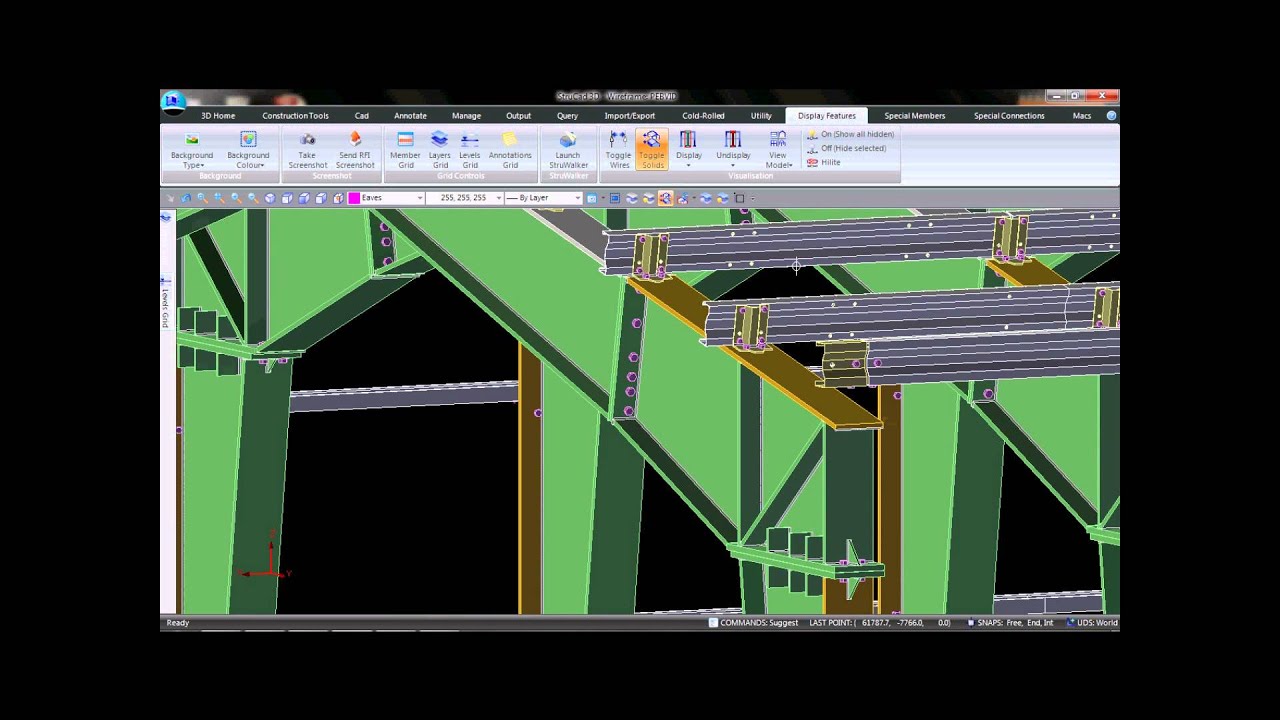
Request your 30-DAY FREE TRIAL atAdvanced analysis and design of elastic-plastic 3D portal frames & ancillary steelwork. Design to BS, Euro & SABS codes.MasterPort Plus is a new and innovative approach to the generation, analysis and design of elastic-plastic portal frames. The software provides a complete management system where all Structural aspects of a 3D portal frame building design can be considered with ease.Using a range of comprehensive generation tools, MasterPort Plus enables you to model, design and generate drawings of almost any portal frame structure in minutes.More videos at.
Comments are closed.